Source: Bureau of Meteorology
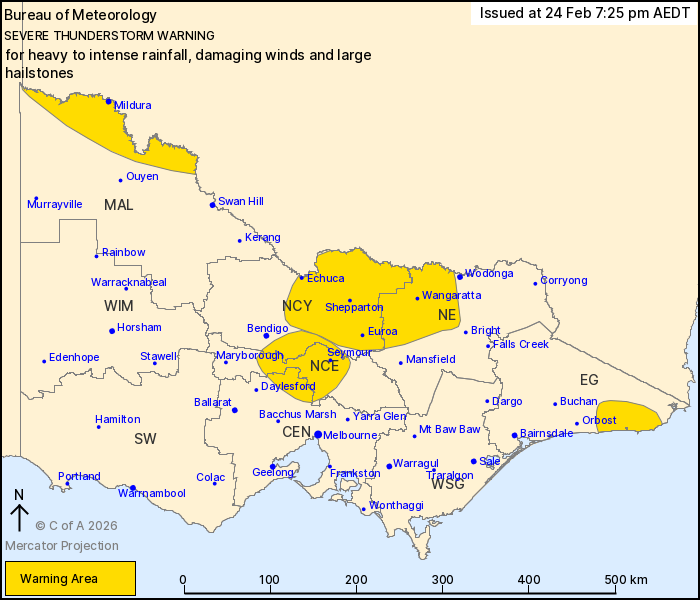
For people in parts of Central, East Gippsland, Mallee, Northern
Country, North Central and North East Forecast Districts.
Issued at 7:25 pm Tuesday, 24 February 2026.
VERY DANGEROUS LINE OF SEVERE THUNDERSTORMS OVER THE NORTH CENTRAL
DISTRICT MOVING SOUTHEAST PRODUCING INTENSE RAINFALL AND POSSIBLE
DAMAGING WIND GUSTS. Other severe thunderstorms producing heavy
rainfall over northern parts of the state. Severe thunderstorms
over East Gippsland producing heavy rainfall and possible large
hail.
Weather Situation: A humid airmass is combining with the passage
of a slow moving trough of low-pressure to generate severe
thunderstorms this evening.
VERY DANGEROUS THUNDERSTORMS are likely to produce intense
rainfall that may lead to dangerous and life-threatening flash
flooding and damaging winds over the next several hours in parts of
the Central, Northern Country and North Central districts.
Locations which may be affected include Seymour, Castlemaine and
Kyneton.
Severe thunderstorms are likely to produce heavy rainfall that may
lead to flash flooding over the next several hours in parts of the
Mallee, Northern Country and North East districts. Locations which
may be affected include Mildura, Shepparton, Wangaratta, Echuca,
Euroa and Yarrawonga.
Severe thunderstorms are likely to produce heavy rainfall that may
lead to flash flooding and large hailstones over the next several
hours in parts of the East Gippsland district. Locations which may
be affected include Cann River.
26.8 mm was recorded at Kyabram in the 30 minutes to 6:45
pm.
A separate Severe Weather Warning for heavy rainfall is also
current for Central, North Central, West and South Gippsland and
parts of Northern Country, North East, Wimmera, East Gippsland,
Mallee and South West Forecast Districts. Please check
https://www.bom.gov.au/weather-and-climate/warnings-and-alerts for
more information.
The State Emergency Service advises that people should:
* If driving conditions are dangerous, safely pull over away from
trees, drains, low-lying areas and floodwater. Avoid travel if
possible.
* Stay safe by avoiding dangerous hazards, such as floodwater,
mud, debris, damaged roads and fallen trees.
* Be aware - heat, fire or recent storms may make trees unstable
and more likely to fall when it's windy or wet.
* Check that loose items, such as outdoor settings, umbrellas and
trampolines are safely secured. Move vehicles under cover or away
from trees.
* Stay indoors and away from windows.
* If outdoors, move to a safe place indoors. Stay away from trees,
drains, gutters, creeks and waterways.
* Stay away from fallen powerlines - always assume they are
live.
* Be aware that in fire affected areas, rainfall run-off into
waterways may contain debris such as ash, soil, trees and rocks.
Heavy rainfall may also increase the potential for landslides and
debris across roads.
* Stay informed: Monitor weather warnings, forecasts and river
levels at the Bureau of Meteorology website, and warnings through
VicEmergency website/app/hotline.
24/Feb/2026 08:38 AM