Source: Bureau of Meteorology
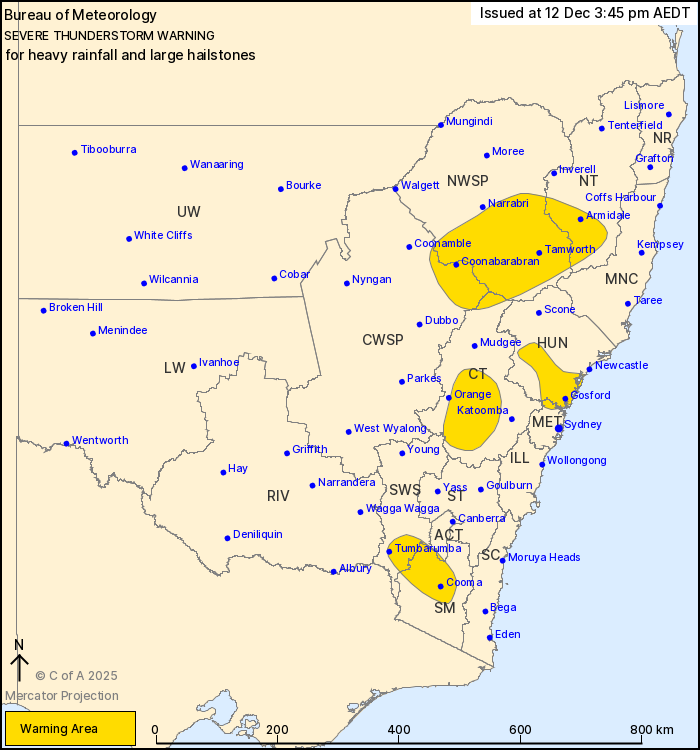
For people in parts of Hunter, Metropolitan, Central Tablelands,
North West Slopes and Plains, Central West Slopes and Plains, South
West Slopes, Snowy Mountains, Australian Capital Territory and
Northern Tablelands Forecast Districts.
Issued at 3:45 pm Friday, 12 December 2025.
Severe thunderstorms for parts of eastern New South Wales
Weather Situation: A humid and unstable airmass brings
thunderstorms to broad areas of NSW today.
Severe thunderstorms are likely to produce heavy rainfall that may
lead to flash flooding over the next several hours in parts of the
Hunter, Metropolitan, South West Slopes, Snowy Mountains,
Australian Capital Territory and Central Tablelands districts.
Locations which may be affected include Gosford, Cooma, Tumbarumba,
Morisset, Wyong and The Entrance.
Severe thunderstorms are likely to produce heavy rainfall that may
lead to flash flooding and large hailstones over the next several
hours in parts of the Central Tablelands, North West Slopes and
Plains, Central West Slopes and Plains, Northern Tablelands and
South West Slopes districts. Locations which may be affected
include Armidale, Tamworth, Coonabarabran, Bathurst, Gunnedah and
Walcha.
Severe thunderstorms are no longer occurring in the Southern
Tablelands district and the warning for this district is
CANCELLED.
76.0 mm was observed at Lake Macquarie in the 2 hours to 2:58
pm.
57.5 mm was observed at Martinsville in the 60 minutes to 2:45
pm.
44.2 mm was observed at Norah Head in the 30 minutes to 07:58
am.
61 mm was observed at Linden in the 2 hours to 07:30 am.
74.5 mm was observed at Kangy Angy in 2 hours to 06:17 am.
70 mm was observed at Lake Macquarie in 3 hours to 03:30 am.
The State Emergency Service advises that people should:
* Move your car under cover.
* Keep clear of creeks and storm drains.
* Don't walk, ride your bike or drive through flood water.
* If you are trapped by flash flooding, seek refuge in the highest
available place and ring 000 if you need rescue.
* Be aware that run-off from rainfall in fire affected areas may
behave differently and be more rapid. It may also contain debris
such as ash, soil, trees and rocks.
* After bushfires, heavy rain and the loss of foliage can make the
ground soft and heavy, leading to a greater chance of
landslides.
* Unplug computers and appliances.
* Avoid using the phone during the storm.
* Stay indoors away from windows, and keep children and pets
indoors as well.
* Stay vigilant and monitor conditions. Note that the landscape
may have changed following bushfires.
* For emergency help in floods and storms, ring the SES (NSW and
ACT) on 132 500.
12/Dec/2025 04:54 AM